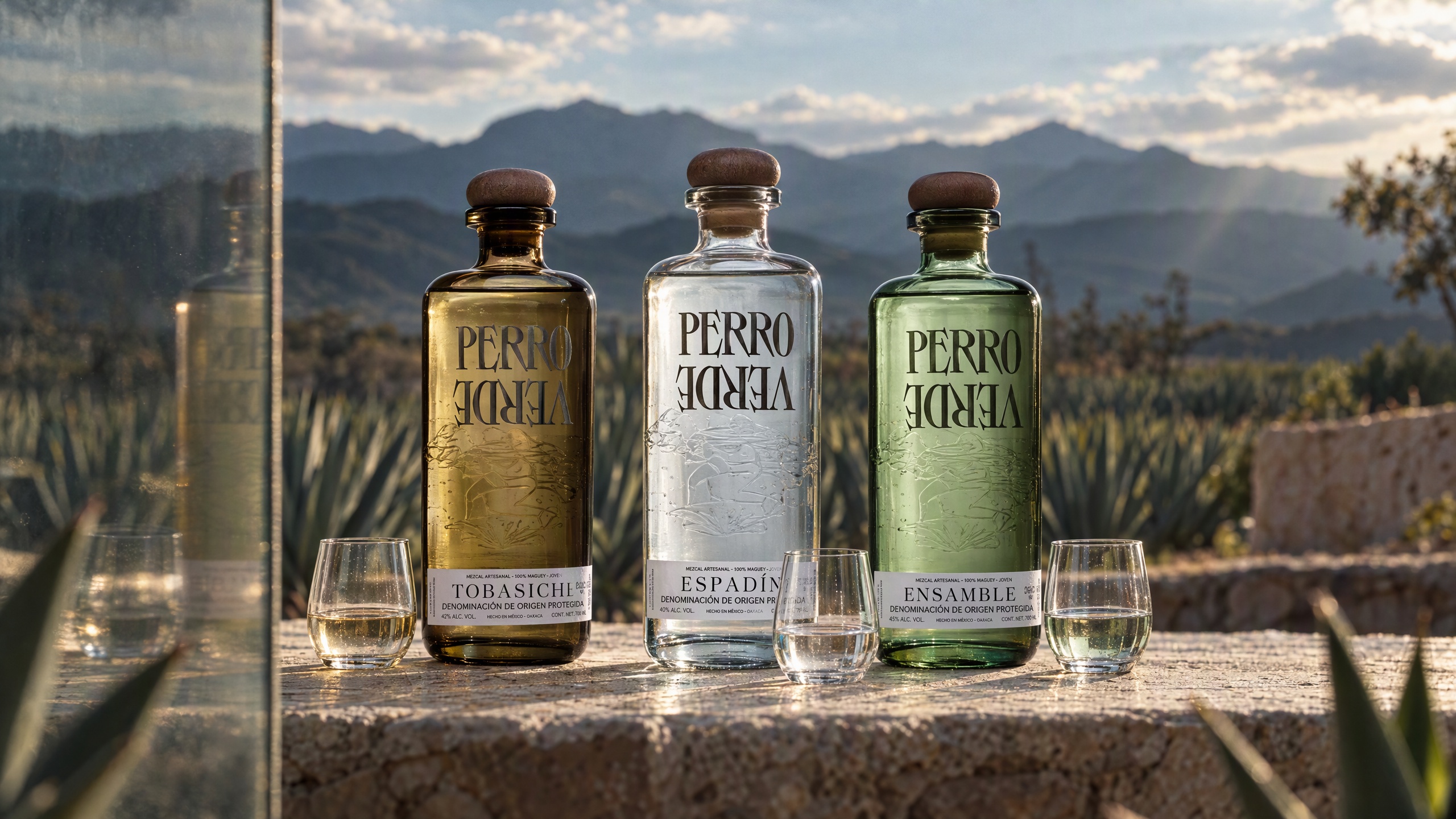
“Smooth” is a subjective impression of balance, not a formal mezcal category. Flavor describes notes such as agave, fruit, herbs and smoke; mouthfeel describes texture; alcohol warmth is another sensation. Agave and production can influence flavor, but no single method guarantees smoothness. Compare small pours side by side and assess each of these qualities separately.
- Smoothness is subjective; it is not a regulated mezcal category or formal tasting scale.
- Agave and production can shape aroma and flavor, but no single method guarantees a smooth result.
- Compare aroma, flavor, mouthfeel, alcohol warmth and finish as separate tasting cues.
- PERRO VERDE’s published process description and expression notes offer concrete details to compare.
What does smooth mezcal taste like?
People use “smooth” for an overall impression that a spirit feels balanced. To describe what creates that impression for you, separate flavor, mouthfeel and alcohol warmth: flavor might include cooked agave, fruit, herbs or smoke; mouthfeel might seem light or oily; alcohol warmth is another sensation. A mezcal can have noticeable smoke or texture and still feel balanced to a particular taster.
Smoothness is subjective, not a formal mezcal category or standardized tasting scale. Mexico’s official standard defines mezcal categories and classes, but does not establish an official smoothness rating. Read the official NOM-070 standard.
Why does mezcal taste smoky, and what else shapes its flavor?
Wood-fired cooking can contribute smoke, but it is only one influence on a mezcal’s aroma and flavor. The official NOM-070 standard permits different cooking methods across its production categories: Mezcal may use pit ovens, masonry ovens or an autoclave; the rules for Mezcal Artesanal and Mezcal Ancestral specify different permitted methods. The standard’s categories also cover other parts of production, so a cooking method by itself does not determine how a bottle will taste. Check the official standard’s production requirements.
Agave and production choices—including cooking, fermentation and distillation—can affect the flavors and aromas that emerge. A sensory study of ten Mexican mezcals found variation in descriptors including floral and smoked aromas; it reports differences among those samples, not a rule for every mezcal. The CIATEJ mezcal glossary describes smokiness as an aroma and flavor that can be conveyed during cooking through the use of different kinds of wood. Read the sensory study and consult the CIATEJ mezcal glossary for additional tasting vocabulary.
How can you compare mezcal flavor?
Taste samples side by side using the same kind of glass and similar-sized pours. Examine each sample, smell gently, then taste; Mexico’s Agriculture Secretariat recommends this general sequence. Record your own impressions instead of trying to match someone else’s preferred descriptors. See the Secretariat’s mezcal tasting guidance.
Use these steps for each pour:
- Look at the spirit, then set the glass down.
- Smell gently. Note aromas such as smoke, cooked agave, herbs, fruit or spice.
- Take a small sip and record the first flavors and what develops afterward.
- Describe mouthfeel separately from alcohol warmth.
- After swallowing, note which flavors remain and for how long.
- Compare notes across samples and decide which profile feels most balanced to you.
A simple grid can help keep the observations distinct:
| What to notice | Questions to ask | Example descriptors |
|---|---|---|
| Aroma | What do you notice before tasting? | Smoke, cooked agave, herbs, fruit |
| Flavor | Which notes arrive first, and which follow? | Citrus, roasted agave, green fruit |
| Mouthfeel | How does the spirit feel on your palate? | Light, rounded, oily |
| Alcohol warmth | How noticeable is the warmth? | Subtle, noticeable, prominent |
| Finish | What remains after the sip? | Herbal, peppery, fruity, smoky |
How do PERRO VERDE’s expressions compare?
PERRO VERDE’s public account gives both a stated point of view and concrete production details. The founders say their aim is for agave’s flavors and aromas to come through without smoke or alcohol overpowering them. The brand describes its process as slow roasting in a pit oven, cold fermentation in pine-wood casks and copper-still distillation. These are the brand’s stated approach and process, not a promise that every person will perceive the result as smooth. Read PERRO VERDE’s account of its approach.
The expressions also provide different tasting profiles and production details to consider side by side:
| Expression | Published tasting profile | Published production details |
|---|---|---|
| PERRO VERDE ESPADIN tasting notes and product details | Roasted agave, lime and mint, with yellow apple and a mellow hint of spice; described as having a smoky touch. | The product page describes Espadín matured for 5–7 years, extracted with a horse-powered mill, roasted in a conical pit oven with Huizache wood and volcanic rocks, naturally fermented in wooden casks, and distilled in copper stills. |
| PERRO VERDE ESPADIN / TOBASICHE BLEND tasting notes and product details | Cooked apple, olives and herbs on the nose; fruit, herbs, spice, roasted agave and citrus on the palate; described as gently smoky. | The product page describes the Espadín component as horse-milled and the Tobasiche component as manually extracted with a mallet; both are described as pit-roasted and naturally fermented in wooden casks. |
| PERRO VERDE TOBASICHE tasting notes and product details | Lemongrass, green melon, green apple, ginger, star fruit and anise, alongside a smoky, spicy aroma and a charred, oily quality. | The product page describes Tobasiche matured for 17 years, manually extracted with a mallet, roasted in a conical pit oven with Huizache wood and volcanic rocks, naturally fermented in wooden casks, and distilled in copper and clay stills. |
There is also a published blind-tasting observation, separate from the brand’s own account. At The Spirits Business’s 2025 Tequila & Mezcal Masters, judge David T. Smith described PERRO VERDE Tobasiche as “oily and bold,” with smoke and resinous green notes, and called it “oily but balanced.” Tobasiche won Gold in its category. This is one judge’s tasting, not a universal verdict on smoothness. Read the 2025 tasting results.
For more context on the brand’s Oaxacan heritage, read the introduction to PERRO VERDE Mezcal.
How do you choose a less smoky mezcal?
Start with the comparison table: look for tasting notes that mention flavors you enjoy alongside smoke, then assess a sample if you have the opportunity. Treat production details as context, not a guarantee of a particular flavor or mouthfeel. Choose by the balance you prefer, rather than by the word “smooth” alone.
To compare PERRO VERDE’s three profiles and product details, explore the mezcal collection.
Frequently asked questions
How can I compare samples without knowing their labels?
Ask someone to pour similar amounts into identical glasses and label them with neutral numbers or letters. Taste and write your notes before learning which bottle is which, then reveal the labels and compare your impressions.
What should I write down during a mezcal tasting?
Record aroma, first flavor, flavors that develop, mouthfeel, alcohol warmth and finish in separate notes. Specific words such as “citrus,” “oily” or “smoky” are more useful for later comparison than a single overall rating such as “smooth.”
What does “artesanal” tell me about a mezcal’s flavor?
It identifies a production category under NOM-070, whose requirements cover stages of production, including cooking, milling, fermentation and distillation. It can provide production context, but the category name alone does not promise a particular flavor or level of smoke.
Explore PERRO VERDE’s mezcal expressions and compare their tasting notes.